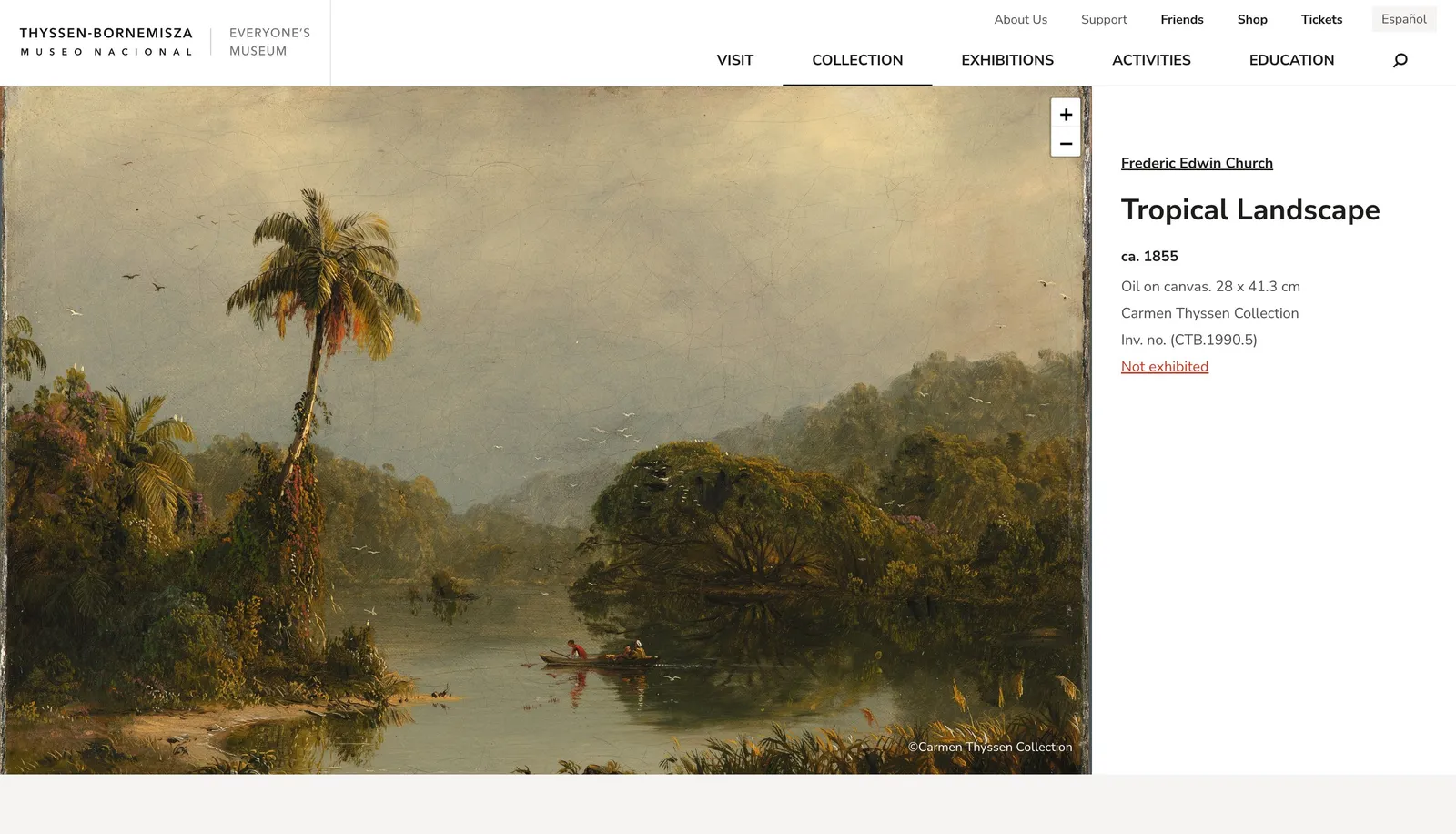
+ − ©Carmen Thyssen Collection Frederic Edwin Church Tropical Landscape ca. 1855 Oil on canvas. 28 x 41.3 cm Carmen Thyssen Collection Inv. no. (CTB.1990.5) Not exhibited Level 2 Permanent Collection Level 1 Permanent Collection Level 0 Carmen Thyssen Collection and Temporary exhibition rooms Level -1 Temporary exhibition rooms, Conference room and EducaThyssen Studio Level 2 Permanent Collection 1 2 3 4 5 6 7 8 9 10 11 12 14 13 15 16 17 18 22 19 20 21 23 24 25 26 27 28 29 Recommended start of the visit Classical rooms Hide icons 1 14th Century. Early Italian Painting 2 15th Century. German and Spanish Painting 3 15th Century. Early Netherlandish Painting 4 15th Century. Italian Painting 5 15th and 16th Centuries. Renaissance Portraiture 6 16th Century. Villahermosa Gallery 7 16th Century. Italian Painting 8 15th and 16th Centuries. German Painting 9 15th and 16th Centuries. German Painting 10 16th Century. Netherlandish Painting 11 Tiziano, Tintoretto, Bassano and El Greco 12 17th Century. Caravaggio and Baroque Painting 13 17th Century. Italian, French and Spanish Painting 14 17th Century. Italian, French and Spanish Painting 15 17th Century. Italian, French and Spanish Painting 16 18th Century. Italian Painting 17 18th Century. Italian Painting 18 18th Century. Italian Painting 19 Classical rooms 20 Classical rooms 21 Classical rooms 22 18th Century. Italian Painting 23 17th Century. Dutch Painting. Landscape 24 18th Century. French and English Painting 25 17th Century. Dutch Painting. Scenes of Daily Life and Interiors 26 17th Century. Dutch Painting. Landscape 27 17th Century. Dutch Painting. Portrait 28 17th Century. Dutch Painting. Landscape 29 19th Century. European Painting. Goya and Romanticism Inspired by the writings of the German naturalist, Alexander von Humboldt, Church travelled to South America in 1853 with Cyrus Field, who would later be known for promoting the trans-Atlantic cable, and again four years later with the artist Louis Rémy Mignot. While Tropical Landscape is undated and unsigned, according to Church scholar, Gerald Carr, it likely comes out of his first trip to South America and most closely resembles View on the Magdalena River (1857, The Manoogian Collection), painted shortly before Church's second trip. Church's journey to Colombia was not without fatigue and hardship as he ascended the Rio Magdalena by canoe and travelled over land by mule, but as the 19th-century critic Henry T. Tuckerman relates, these "trials were soon forgotten, when the splendours of an exuberant and radiant vegetation burst upon his sight, and he was enabled at leisure to explore scenes of alternate wildness and luxury, full of novel effects and suggestive traits for the pencil." Writing in his journal in Spanish, a language he was newly acquiring, Church expressed his delight in the "vegetacion exuberante y verde" he discovered along the Rio Magdalena, noting at one time: "Hoy el exuberancia del vegetacion ha deleytandome mas que en qualquier tiempo antes." Paintings from his first expedition to the Southern "terrestrial paradise" were warmly received by New York critics when exhibited at the National Academy in 1855. La Magdalena (Scene of the Magdalene, 1854, National Academy of Design) was considered by one reviewer to be a "most elaborate and apparently most truthful portraiture of that marvellous tropical vegetation, which bedecks the river-banks." While no extant drawing directly relates to Tropical Landscape, a number of studies Church made on his May 1853 journey along the Rio Magdalena are suggestive of its scenery. Church was particularly attracted to the immense trees with their spreading foliage as seen in the right middle distance of his canvas. On one drawing made of a similar tree (Cooper-Hewitt Museum, 1917-4-850) he noted: "massive tree, longitudinal / masses with many openings showing / the sky between." A similar umbrageous tree is found in View on the Magdalena River, which also shares the palm tree on the left and boatmen in the foreground, but whose background is distinctly different. Church's Tropical Landscape is likely a synthetic view distilled from the experiences of his journey. As in many of his paintings of the South American landscape, including his 1858 study (Olana State Historical Site) for his masterpiece, The Heart of the Andes (1859, The Metropolitan Museum, New York), a single palm dominates the composition. The palm strengthens the identification of such tropical scenes as an Edenic paradise. Church's teacher, Thomas Cole, had included towering palms in his allegorical painting, The Garden of Eden (1828, Amon Carter Museum, Fort Worth, Texas), which drew upon Milton's verses for its inspiration; and although not specifically identified as the Tree of Life, the palm was often equated with it. Nineteenth-century viewers of Church's paradisiacal landscapes of the tropics expressed little doubt that they were viewing "the garden inhabited by man before his fall." Kenneth W. Maddox FIND OUT MORE 19th Century19th Century. North American Painting. Hudson River SchoolPaintingOilcanvas LISTEN DOWNLOAD IMAGE PRINT PAGE More details about Tropical Landscape Vídeo "Church". Curso "Autores de la Colección" Related exhibitions Baron Thyssen-Bornemisza Centenary Temporary Exhibition American Art from the Thyssen Collection From 14 December 2021 to 16 October 2022 Temporary Exhibition Exploring Eden. 19th century american landscape painting From 29 September 2000 to 14 January 2001 Temporary Exhibition Painting Nature from Brueghel to Van Gogh From 1 October 1999 to 16 January 2000 Temporary Exhibition From Canaletto to Kandinsky. Masterworks from the Carmen Thyssen-Bornemisza Collection From 21 March to 8 September 1996 Related content Research project American Art from the Thyssen Collection. 2021-2022 With the support of Terra Foundation for American Art Products and publications Tropical landscape 17,00 € VISIT ONLINE SHOP Más obras de arte de la Colección Thomas Cole Expulsion. Moon and Firelight ca. 1828 Thomas Cole Cross at Sunset ca. 1848 Frederic Edwin Church South American Landscape 1856 Frederic Edwin Church Cross in the Wilderness 1857 Previous Next