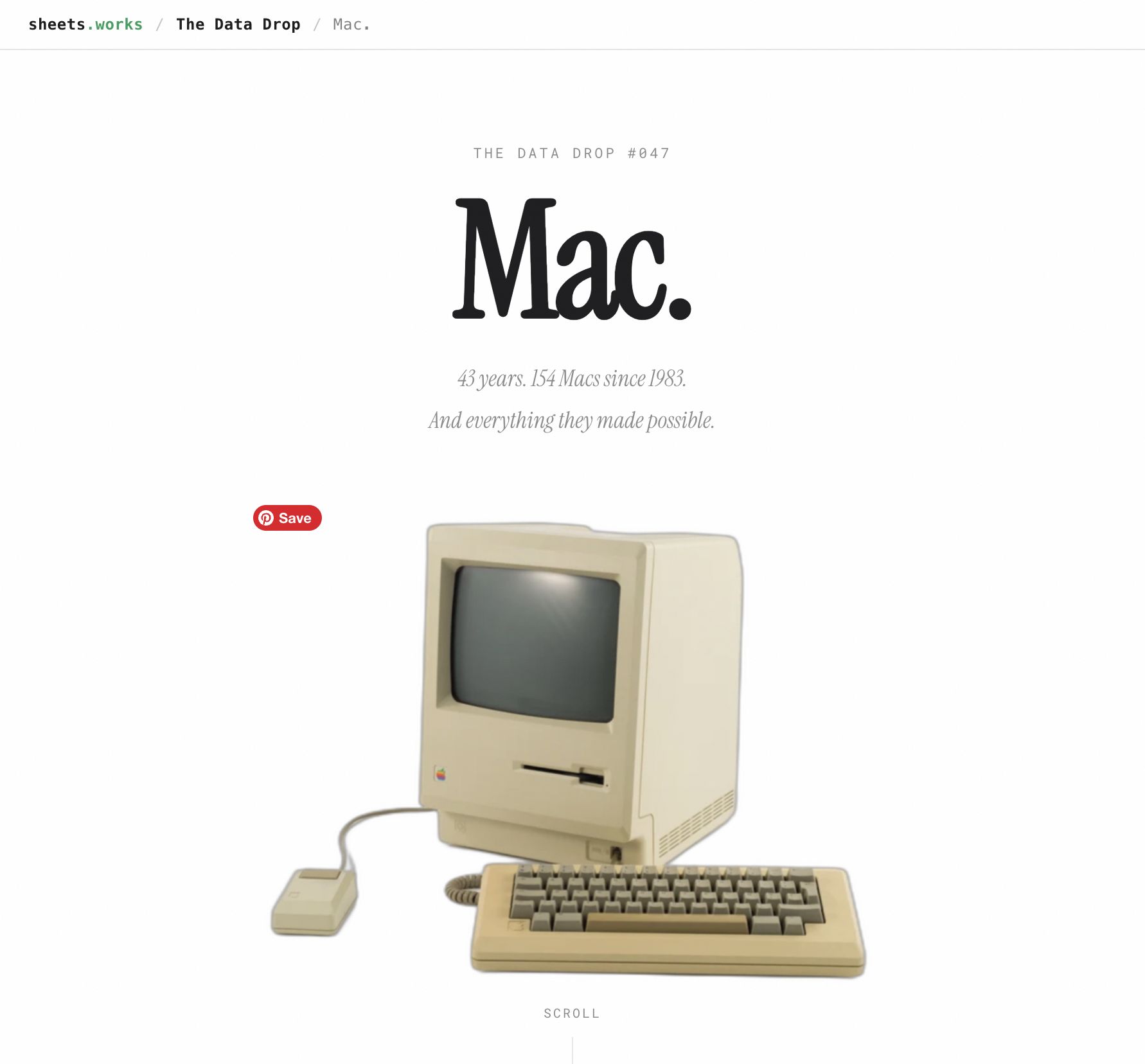
sheets.works / The Data Drop / Mac. THE DATA DROP #047 Mac. 43 years. 154 Macs since 1983. And everything they made possible. SCROLL THE TIMELINE 19 moments. 43 years. 1983 Apple Lisa 1983 · 68K The $9,995 experiment. Apple announced the Lisa in January 1983 and shipped it that June. One of the first personal computers with a graphical user interface: windows, icons, a mouse, a trash can. It was years ahead of everything else. It failed commercially. In 1989, Apple buried about 2,700 unsold units in a Utah landfill for a tax write-off. $9,995 · ROUGHLY 60,000 SOLD 1984 · 68K 128 KB. One ad. Everything. The Macintosh shipped on January 24, 1984. A 9-inch screen, 128 KB of memory, a floppy drive. Steve Jobs pulled it out of a bag on stage. It said "Hello, I'm Macintosh." Two days earlier, Apple aired a Ridley Scott-directed Super Bowl ad with the tagline "And you'll see why 1984 won't be like '1984.'" ~250,000 SOLD BY END OF 1984 1987 · 68K The app that foreshadowed the web. HyperCard shipped free with every Mac. It had hyperlinks, multimedia, and scripting. In 1987. The World Wide Web wouldn't exist for four more years. Web pioneers like Robert Cailliau cited it as inspiration. Apple killed it in 2004. 1989 · 68K 32-bit guts. 1984 case. The Mac II (1987) brought color. The SE/30 (1989) crammed a 32-bit Motorola 68030 into the iconic compact Mac case. It became the most enduring favorite of the early-Mac era. 1991 · 68K The first real laptop. Designed by Sony. Keyboard pushed back, trackball in front. The PowerBook 100 pioneered the modern laptop layout. Most laptops since have followed some version of this template. 2.3 KG 1994 · POWERPC The first chip switch. In 1994, Apple moved off the Motorola 68k that had powered every Mac since 1984. They switched to PowerPC, developed by the AIM alliance: Apple, IBM, and Motorola. Old 68k software ran through a built-in emulator, slower than native. The first of three processor transitions. 68K TO POWERPC 1997 · POWERPC Here's to the crazy ones. By 1997, Apple was in serious financial trouble. Some estimates put the company weeks from insolvency. Steve Jobs came back. The first thing he shipped wasn't a computer. It was a two-word ad campaign. 1998 · POWERPC Bondi Blue. No floppy. USB only. The iMac G3 was translucent. It had a handle. It was the first mainstream computer without a floppy drive. USB-only (no ADB, no SCSI, no serial). It popularized USB peripherals industry-wide. 800,000 sold in five months. Apple was saved. In January 1999 came five flavors: blueberry, grape, tangerine, lime, strawberry. 800,000 SOLD IN 5 MONTHS 2000 · POWERPC 8x8x8 inches. No fan. No sales. A perfect cube, suspended in clear plastic, no fan. The G4 Cube was a sculpture. Early units had visible lines in the acrylic. Customers called them cracks, Apple called them mold lines. It sold roughly a fifth of its forecast. Apple killed it in 12 months. MoMA added it to their permanent collection. ~150,000 SOLD VS ~800,000 FORECAST 2001 · POWERPC Aqua. The dock. Everything new. Apple threw away the entire operating system. Mac OS X shipped in March 2001, built on NeXTSTEP (the OS Steve developed at NeXT after leaving Apple). Translucent Aqua buttons, a dock, and Terminal.app. The Mac became a developer's machine overnight. 2004 · POWERPC Every Mac became a studio. Apple shipped GarageBand free with every Mac. Then iMovie. Then iPhoto. The Mac stopped being a computer and became a creative tool. A kid in a bedroom could now record an album, edit a film, or build a website. All on a $999 machine. 2006 · INTEL Transitioning to Intel. On June 6, 2005 at WWDC, Steve Jobs said "we are going to begin transitioning the Macs to using Intel microprocessors." Seven months later, the first Intel Macs shipped. The full transition took 14 months, a year ahead of schedule. Old software ran through Rosetta translation. POWERPC TO INTEL 2008 · INTEL Every app started on a Mac. The iPhone SDK launched in March 2008, the App Store in July. Every iOS app is written in Xcode, which only runs on macOS. Apple has paid developers over $400 billion cumulatively. The only way to build for iPhone has always been on a Mac. ~1.9 MILLION APPS 2008 · INTEL The manila envelope. Steve Jobs slid a laptop out of a manila envelope on stage. The MacBook Air. The thinnest laptop in the world at the time. One USB port. Most laptop makers spent the next decade chasing the same wedge shape. 1.36 KG 2013 · INTEL Apple's rare apology. The 2013 Mac Pro, a black cylinder everyone called the Trash Can, was a thermal disaster. GPUs throttled. Nothing was upgradable. Apple stopped redesigning it for six years. In 2017, they invited five journalists to campus and apologized on the record. 6 YEARS WITHOUT A REDESIGN 2016 · INTEL The butterfly era. The MacBook Pro shipped with a Touch Bar and a butterfly keyboard. The keys broke constantly. The Touch Bar confused people. Apple removed the SD card slot, the HDMI port, and MagSafe. Apple eventually paid $50 million in 2022 to settle a class-action lawsuit over the keyboards. 2020 · APPLE SILICON $999 beat the $5,999 Mac Pro. Apple announced the M1 on November 10, 2020. A $999 fanless laptop that beat the base $5,999 Mac Pro in single-core Geekbench. Apple's own silicon, designed from scratch. Up to 18-hour battery life. Silent. Cool to the touch. Qualcomm and Intel spent the next four years chasing the same fanless benchmark. INTEL TO APPLE SILICON 2021 · APPLE SILICON Every mistake reversed. The 2021 MacBook Pro brought back MagSafe, HDMI, and the SD card slot. It killed the Touch Bar. Function keys returned. Reviewers called it the apology Apple owed pros. 2026 · APPLE SILICON An iPhone chip. $599. March 2026. The MacBook Neo shipped with an A18 Pro. An iPhone chip, not an M-series. $599. Color-coordinated keyboards in Blush, Citrus, Indigo. The cheapest Mac laptop Apple has ever shipped. $599 · A18 PRO $599 THE CHEAPEST MAC LAPTOP EVER THE COLORS 14 years of beige. Then Bondi Blue. From 1984 to 1997, every Mac was beige. Then the iMac G3 arrived in Bondi Blue and Apple never looked back. Here's every color of every Mac, chronologically. MOTOROLA 68K · 1984–1996 47 MACS POWERPC · 1994–2006 45 MACS INTEL · 2006–2020 39 MACS APPLE SILICON · 2020–2026 23 MACS THE WEIGHT From 7.2 kg to 1.23 kg. The Macintosh Portable (1989) weighed 7.2 kg. The MacBook Neo (2026) weighs 1.23 kg. Here's every laptop Mac's weight, from heaviest to lightest. 1989 2026 7.2 kg PORTABLE · 1989 1.23 kg NEO · 2026 MADE ON A MAC 8% market share. Most of what you love. Apple's share of global PC shipments has typically sat between 5% and 10%. Windows dominates. But a surprising amount of what we watch, hear, design, and ship started on a Mac. Photoshop Launched Mac-only in 1990. The tool that defined digital imaging ran nowhere else for its first three years. 1990 The World Wide Web Tim Berners-Lee built the first browser and server on a NeXT. NeXT became the foundation of macOS. 1991 Keynote Steve Jobs hated PowerPoint so much Apple built Keynote. Every Apple launch since has used it. 2003– Toy Story The first fully CGI feature film. Pixar used Macs alongside Sun and SGI machines in their studio. 1995 The iPod Interface designed on a Mac. The product that funded the iPhone. 2001 GarageBand Grimes made Visions on it. Steve Lacy produced "PRIDE." on Kendrick's DAMN. using GarageBand on his iPhone. A free app that comes with every Mac. 2004– Every iPhone App Xcode only runs on macOS. Every iOS app in the App Store was compiled on a Mac. Apple has paid developers over $400 billion. 2008– Billie Eilish When We All Fall Asleep, Where Do We Go? Recorded in Finneas's bedroom in Highland Park. On a Mac. With Logic Pro. Swept the Big Four Grammys in 2020. 2019 Hollywood Films The Social Network (Oscar-winning edit), 300, No Country for Old Men. Major films edited on Final Cut Pro. 1999– Sketch & Figma Sketch launched Mac-only in 2010 and redefined UI design. Most designers using Figma work on Macs. 2010– Logic Pro Music Calvin Harris, Mac Miller, countless bedroom producers. Logic Pro has been Mac-only since Apple acquired Emagic in 2002. 2004– WordPress Co-founded by Matt Mullenweg and Mike Little in 2003. Now powers 43% of all websites on the internet. 2003 This page. Built on a Mac. Obviously. 2026 The Mac never won the market. It won the culture. THE PRICE OF A MAC From $9,995 to $599. In 1983, the cheapest way into a Mac cost more than a new car. Today it costs less than an AirPods Max. Here's every Mac's launch price, from Lisa to Neo. MOST EXPENSIVE CHEAPEST 68K ERA POWERPC INTEL APPLE SILICON Apple Lisa 1983 · 68k $9,995 Macintosh IIfx 1990 · 68k $9,869 Macintosh IIx 1988 · 68k $7,769 20th Anniversary Macintosh (TAM) 1997 · PowerPC $7,499 Macintosh Quadra 900 1991 · 68k $7,200 Macintosh Quadra 950 1992 · 68k $7,200 Mac Pro (M2 Ultra) 2023 · Apple Silicon $6,999 Macintosh Portable 1989 · 68k $6,500 Macintosh IIci 1989 · 68k $6,269 Mac Pro (Late 2019, Cheese Grater 2) 2019 · Intel $5,999 Macintosh Quadra 700 1991 · 68k $5,700 PowerBook G3 (Kanga) 1997 · PowerPC $5,700 Macintosh II 1987 · 68k $5,498 Macintosh IIcx 1989 · 68k $5,369 PowerBook 540c 1994 · 68k $5,300 Power Macintosh 9500 1995 · PowerPC $5,300 iMac Pro 2017 · Intel $4,999 Macintosh Quadra 840AV 1993 · 68k $4,869 Macintosh Quadra 800 1993 · 68k $4,679 PowerBook 170 1991 · 68k $4,600 PowerBook 3400c 1997 · PowerPC $4,500 Power Macintosh 9600 1997 · PowerPC $4,400 Macintosh SE/30 1989 · 68k $4,369 Power Macintosh 8100 1994 · PowerPC $4,249 Macintosh XL 1985 · 68k $3,995 $9,995 LISA · 1983 $2,495 AVERAGE $599 NEO · 2026 THE ARCHIVE All 152. ALL 68K POWERPC INTEL APPLE SILICON NEO 154 Macs Apple Lisa 1983 · 68k · $9,995 Apple Lisa 2 1984 · 68k · $3,495 Macintosh 128K 1984 · 68k · $2,495 Macintosh 512K 1984 · 68k · $3,195 Macintosh XL 1985 · 68k · $3,995 Macintosh Plus 1986 · 68k · $2,599 Macintosh SE 1987 · 68k · $2,900 Macintosh II 1987 · 68k · $5,498 Macintosh IIx 1988 · 68k · $7,769 Macintosh SE/30 1989 · 68k · $4,369 Macintosh IIcx 1989 · 68k · $5,369 Macintosh Portable 1989 · 68k · $6,500 Macintosh IIci 1989 · 68k · $6,269 Macintosh IIfx 1990 · 68k · $9,869 Macintosh Classic 1990 · 68k · $999 Macintosh IIsi 1990 · 68k · $3,769 Macintosh LC 1990 · 68k · $2,499 Macintosh Classic II 1991 · 68k · $1,900 Macintosh Quadra 700 1991 · 68k · $5,700 Macintosh Quadra 900 1991 · 68k · $7,200 PowerBook 100 1991 · 68k · $2,500 PowerBook 140 1991 · 68k · $2,900 PowerBook 170 1991 · 68k · $4,600 Macintosh LC II 1992 · 68k · $1,699 Macintosh Quadra 950 1992 · 68k · $7,200 Macintosh Performa 200 1992 · 68k · $1,250 Macintosh IIvi 1992 · 68k · $1,900 Macintosh IIvx 1992 · 68k · $2,950 PowerBook Duo 230 1992 · 68k · $2,609 Macintosh Color Classic 1993 · 68k · $1,390 Macintosh LC III 1993 · 68k · $1,349 Macintosh Quadra 800 1993 · 68k · $4,679 Macintosh Centris 610 1993 · 68k · $1,900 Macintosh Centris 650 1993 · 68k · $2,700 Macintosh LC 520 1993 · 68k · $2,000 Macintosh Quadra 840AV 1993 · 68k · $4,869 Show more × The Data Drop, every Tuesday. One interactive data story, every Tuesday. No filler. Free. Subscribe Built by one person over weeks. No sponsors, no ads, free forever. If you enjoyed this, consider buying me a coffee. ☕ Buy me a coffee © sheets.works · More data drops · Home Save