AI Won’t Replace Designers. But It Is Changing What Designers Get Paid For.
Let’s get the scary part out of the way first.
https://medium.com/design-bootcamp/ai-wont-replace-designers-but-it-is-changing-what-designers-get-paid-for-1f030abcfecdReader - page text saved at the timeMember-only story
AI Won’t Replace Designers. But It Is Changing What Designers Get Paid For.
Yashita Sharma
Follow
7 min read
·
5 days ago
235
4
3
Let’s get the scary part out of the way first.
Press enter or click to view image in full size
Image by Author
Yes, AI can generate UI layouts now. Yes, it can write UX copy, produce user research summaries, build prototypes from a text prompt, and spit out a dozen visual directions in the time it used to take you to make a single moodboard. Yes, some of the things you spent years getting good at can now be done by a tool that costs $20 a month.
That’s real. It’s not hype, and pretending it isn’t happening doesn’t help anyone.
But here’s what’s also real: the designers who are thriving right now aren’t the ones fighting against AI. They’re the ones who quietly figured out what AI can’t do, and started getting very, very good at exactly that.
What AI Is Actually Good At
Before we talk about what this means for your career, it’s worth being honest about what AI is genuinely good at. Because the answer is: quite a lot.
AI is good at execution. Give it a clear brief and it will produce something usable, often in seconds. It’s good at generating options, showing you ten versions of something so you can pick and refine rather than start from nothing. It’s good at the mechanical parts of writing: first drafts of tooltips, error messages, onboarding copy. It’s good at compressing research notes, spotting patterns in survey responses, and summarizing what users said across a dozen interviews.
It’s also getting better at all of this faster than most people expected.
The result is that a lot of the work that used to be billable hours, the time spent producing raw material is compressing. What took a week now takes a day. What took a day now takes an hour.
And this is where a lot of designers quietly panic. Because if the production time shrinks, does the value shrink with it?
The answer is no. But only if you understand what the value was actually coming from.
The Shift Nobody Is Talking About Clearly Enough
Press enter or click to view image in full size
Image by Author
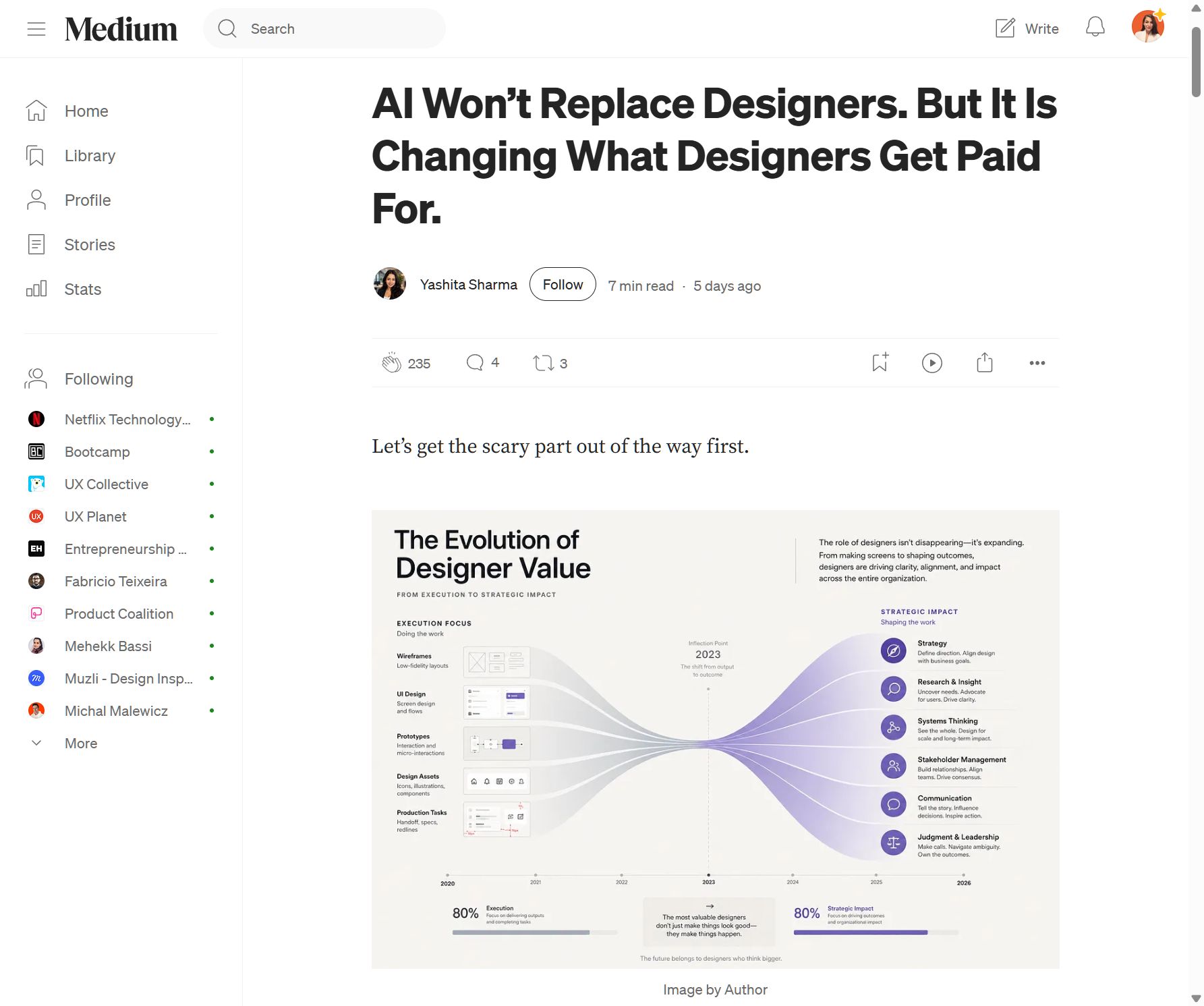
Here’s the thing about design work that AI has made impossible to ignore: a lot of what beginner designers got paid for was output. Screens. Wireframes. Prototypes. Assets. The deliverables.
But what experienced designers get paid for has always been something different. It’s judgment. It’s knowing which problem is worth solving before you design the solution. It’s understanding why users behave the way they do, not just what they click on. It’s making a call when the data says one thing and the user research says another. It’s sitting in a room with a VP and a confused product strategy and finding the thread that ties it together.
AI cannot do any of that.
What’s happening right now is that the gap between “production designer” and “thinking designer” is becoming impossible to hide. AI is doing more of the production work, which means the only thing left that’s uniquely yours is the thinking.
This isn’t a crisis for designers who were always leading with thinking. It’s actually a relief, the work they were already doing is now clearly the most valuable thing on the table.
But for designers who were leaning heavily on execution speed as their edge? This is a moment to reckon with.
What Designers Are Actually Getting Paid For Now
Press enter or click to view image in full size
Image by Author
Let me be specific. Here’s what the market is rewarding in 2026.
Problem framing- The ability to look at a vague business goal, “we want to improve retention”, and turn it into a precise design question worth answering. This sounds simple. It is not simple. Most teams are solving the wrong problems beautifully, and the designer who can spot that early is worth an enormous amount.
Taste and judgment- AI can generate options. It cannot tell you which one is right for your specific users, your product’s voice, your company’s moment. That editorial sense, the ability to look at ten things and know which one matters and why, is deeply human and increasingly rare.
Systems thinking- Understanding not just how a single screen works but how a design decision ripples across the entire product experience. What happens to the mobile experience when you change this flow? What does this pattern imply for how we’ll handle edge cases in six months? AI doesn’t think in systems. It thinks in responses.
Stakeholder translation- The ability to take a design decision and explain it in language that a CEO, an engineer, a data analyst, and a customer support rep all find meaningful, in the same meeting. This is communication as a craft, and it’s something AI tools can assist with but cannot replace.
Ethics and user advocacy- As products get more powerful, the question of “should we build this” is becoming as important as “how do we build this.” Designers are often the only people in the room consistently asking about user impact, long-term consequences, and the gap between what a feature promises and what it delivers. That voice matters more than ever.
The Trap to Avoid
There’s a version of this moment where designers try to out-AI the AI. They learn every tool, chase every workflow, stack every shortcut, and end up being very efficient at producing things nobody needed.
Speed of execution has never been the point. Good design has always been about solving the right problem in a way that actually works for people. AI makes you faster at the making part. It does nothing for the clarity part.
The trap is mistaking tool fluency for strategic value. Knowing how to use AI in your workflow is table stakes now. It’s like knowing how to use Figma was table stakes three years ago. It gets you in the room. What keeps you in the room is everything else.
What This Means If You’re Early in Your Career
If you’re a beginner designer reading this, I want to be honest with you rather than reassuring.
The entry-level market is harder right now. Some of it is economic. Some of it is that AI has absorbed a portion of the work that used to be the training ground for junior designers, the execution-heavy tasks, the asset production, the first-draft wireframes. That’s a real problem, and it’s worth acknowledging.
But here’s what’s also true: the designers who are building the right skills right now will be extraordinarily well-positioned in two or three years. Because there’s going to be a significant shortage of designers who can actually think, who understand users, who can shape strategy, who can navigate ambiguity without leaning entirely on templates or AI output.
The path forward is to learn AI workflows and use them to buy yourself time for the harder work. Let the tools handle the production. Use the time you save to get better at research, at systems thinking, at business fluency, at communication. That’s the investment that compounds.
What This Means If You’re Mid-Career
This is actually a great moment for mid-level designers, if you use it right.
You already have context AI doesn’t have: you’ve shipped things, watched them succeed and fail, built relationships with engineers, sat through enough bad product reviews to know what “this doesn’t feel right” actually means. That institutional knowledge and accumulated judgment is valuable.
What you need to do is make it visible. Stop underselling the thinking you’re doing. Document your reasoning. Speak up about strategy, not just execution. Use AI to handle more of the output so you can show up more fully in the decisions.
The designers who thrive through this shift aren’t the ones who resist the tools or the ones who disappear into them. They’re the ones who use the tools to do more of the work that actually matters.
The Honest Summary
Press enter or click to view image in full size
Image by Author
AI is changing what designers get paid for. Not by taking the job, by making it very clear which parts of the job were always the most valuable, and which parts were just filling time.
The production layer is getting cheaper and faster. The thinking layer is getting more important and, in some ways, more scarce.
If you’re building your career around output, it’s time to start building it around judgment. Not because the output doesn’t matter, it always will, but because the output is no longer enough to differentiate you.
The good news is that judgment is learnable. It just takes a different kind of practice than learning a new tool.
Start paying attention to why designs work, not just how they look. Start asking the questions your PM hasn’t asked yet. Start connecting your design decisions to outcomes that the business cares about. Start advocating for users in rooms where users aren’t represented.
That’s the work. It always was.
AI just made it impossible to ignore.